This week in my teacher education mathematics class we visited a problem of stacking cups. The problem was created in a few levels. First our instructor showed us one cup and posed the question of how many cups tall she was. We all provided our estimations. These were recorded to be revisited later.
Next we were asked what information we would need to find out an exact answer. We decided that we would need the height of the cup and the height of our instructor. From here it wasn't very difficult to solve for the number of cups. We chose to stack the cups in alternation of inversion. All we needed to do was divid the height of the instructor by the height of one cup. This would give us the height of our instructor with cups as the unit of measure. We compared this to the estimations to see which groups were close. This provides opportunity to discuss errors.
Our instructor then posed the next level of the problem; we had to stack the cups all the same way (how they came in their packaging). Now she asked what new information we might need to solve the question. We decided that we needed to know the height of the "lip" of the cup. From here the solve was a little more difficult than before but still easily comprehended. You would have the height of one cup (the top cup) plus x number of cups to reach the height of the instructor.
At this point the math gets a little interesting and the connection to linear equations becomes evident. With a group of students you can have them develop the equation that represents this linear relationship from only the information given so far. The y-intercept would be the height of one cup and the slope of the line would be the height of the "lip" of the cup.
Another approach to this problem could be as follows. Provide the students with two district heights of stacked cup (i.e., 5 cups is 20cm high and 15 cups is 32cm high.) From here the students could use the two points as coordinate points and develop a linear equation to represent it from here. This would involve them deriving the slope of the relationship with ∆Y/∆X.
Overall, this is engaging activity and provides easy and practical connection to linear equations. Furthermore, it is easily modified to allow for differentiated instruction which as educators know is fundamentally important to a good less.

Tuesday, 31 January 2017

Tuesday, 24 January 2017
Developing a Conceptual Understanding of Dividing Fractions
?Why do We Invert and Multiply?
If you ask someone how to divide two fractions they will generally respond with the timeless rule of "invert and multiple." When I think back to my math education this was exactly how they taught me to divide fractions. It was simply instructed as one of those things you need to memorize and will always work. To be honest, I have not given it much thought since then because I easily remembered this rule and that has been good enough.
I have given a lot of thought this past week on the conceptual ideas of dividing factions, trying to wrap my mind around it. I tried not to look at literature or other explanations on building a conceptual understanding as a means to express this understanding as my own work. With that being said, I am sure there are many more complete explanations out there, but I do hope this can serve as a description of my basic understanding.
I built a better understanding of this by going through a process of different division questions with increasing complexity and looking at them conceptually. The process went from dividing whole numbers by whole numbers to whole numbers by fractions to fractions by whole numbers to simple fractions by simple fractions. I am still struggling working with the conceptual representation of the division of complex fractions, but hope the ideas of a simple fraction can be extrapolated.
Dividing whole numbers by whole numbers.
Lets look at 4÷1=4.
For this equation we have 4 whole parts divided by 1.
OR
We are looking at how many times 4 can be split into groups of one.
OR
We are looking at how many times 1 can fit into 4.
With the purpose of conceptualizing division I find it makes the most sense to look at this through third example. It is easy to visualize this idea.
Dividing whole numbers by simple fractions.
Lets look at 4÷2/3=6.
For this equation we have 4 whole parts divided by 2/3.
OR
We are looking at how many times 4 can be split into groups of 2/3s.
OR
We are looking at how many times 2/3 can fit into 4.
Still looking at the third example we are trying to visualize 2/3 fitting into 4 wholes. This is easily expressed using circles. Figure 1 shows that you need 6 2/3's to fill the 4 wholes. For this reason the answer is 6.
Dividing simple fractions by whole numbers.
Lets look at 2/3÷4=1/6
For this equation we have 2/3 divided by 4.
OR
We are looking at how much of 2/3 can be divided into 4 groups.
OR
We are looking at how many times 4 can fit into 2/3.
Still looking at the third example, we are trying to visualize how much of a 4 wholes will fit into a 2/3 section. Looking at it this way, we visualize the 4 wholes as one entity and the 2/3s as a second entity. We are trying to see much of the first entity fits into the second. I find this easiest to visualize using rectangles. Figure 2 shows that you need 1/6 of the 4 wholes to fill the 2/3s.
Dividing simple fractions by simple fractions.
Lets look at 3/4÷1/2=3/2
For this equation we have 3/4 divided by 1/2.
OR
We are looking at how much of 3/4 can be divided into groups sized 1/2.
OR
We are looking at how many times 1/2 can fit into 3/4.
Again, using the third example and the same ideas we have developed in the previous section, we can tackle this problem. We look at 1/2 as one entity and the 3/4 as a second entity. We are trying too see how much of the first entity fits into the second. Again, we can use rectangles to help visualize this in Figure 3; this shows you need 3/2 of 1/2 to fill 3/4 OR 1 1/2 of 1/2 to fill 3/4.
Concluding Thoughts
I hope to continue thinking through the conceptual models of dividing fractions and revisit this post to include an evaluation of dividing complex fractions by complex fractions that I am happy with. At the current time I have not been able to articulate it in a way I feel adds to this blog.
All in all, I hope the first few examples have provided a deeper understanding in to the why and how we divide fractions.
Dividing whole numbers by whole numbers.
Lets look at 4÷1=4.
For this equation we have 4 whole parts divided by 1.
OR
We are looking at how many times 4 can be split into groups of one.
OR
We are looking at how many times 1 can fit into 4.
With the purpose of conceptualizing division I find it makes the most sense to look at this through third example. It is easy to visualize this idea.
Dividing whole numbers by simple fractions.
Lets look at 4÷2/3=6.
For this equation we have 4 whole parts divided by 2/3.
OR
We are looking at how many times 4 can be split into groups of 2/3s.
OR
We are looking at how many times 2/3 can fit into 4.
 |
| Figure 1 (Original Content by Author) |
Still looking at the third example we are trying to visualize 2/3 fitting into 4 wholes. This is easily expressed using circles. Figure 1 shows that you need 6 2/3's to fill the 4 wholes. For this reason the answer is 6.
Dividing simple fractions by whole numbers.
Lets look at 2/3÷4=1/6
For this equation we have 2/3 divided by 4.
OR
We are looking at how much of 2/3 can be divided into 4 groups.
OR
We are looking at how many times 4 can fit into 2/3.
 |
| Figure 2 (Original Content by Author) |
Dividing simple fractions by simple fractions.
Lets look at 3/4÷1/2=3/2
For this equation we have 3/4 divided by 1/2.
OR
We are looking at how much of 3/4 can be divided into groups sized 1/2.
OR
We are looking at how many times 1/2 can fit into 3/4.
 |
| Figure 3 (Original Content by Author) |
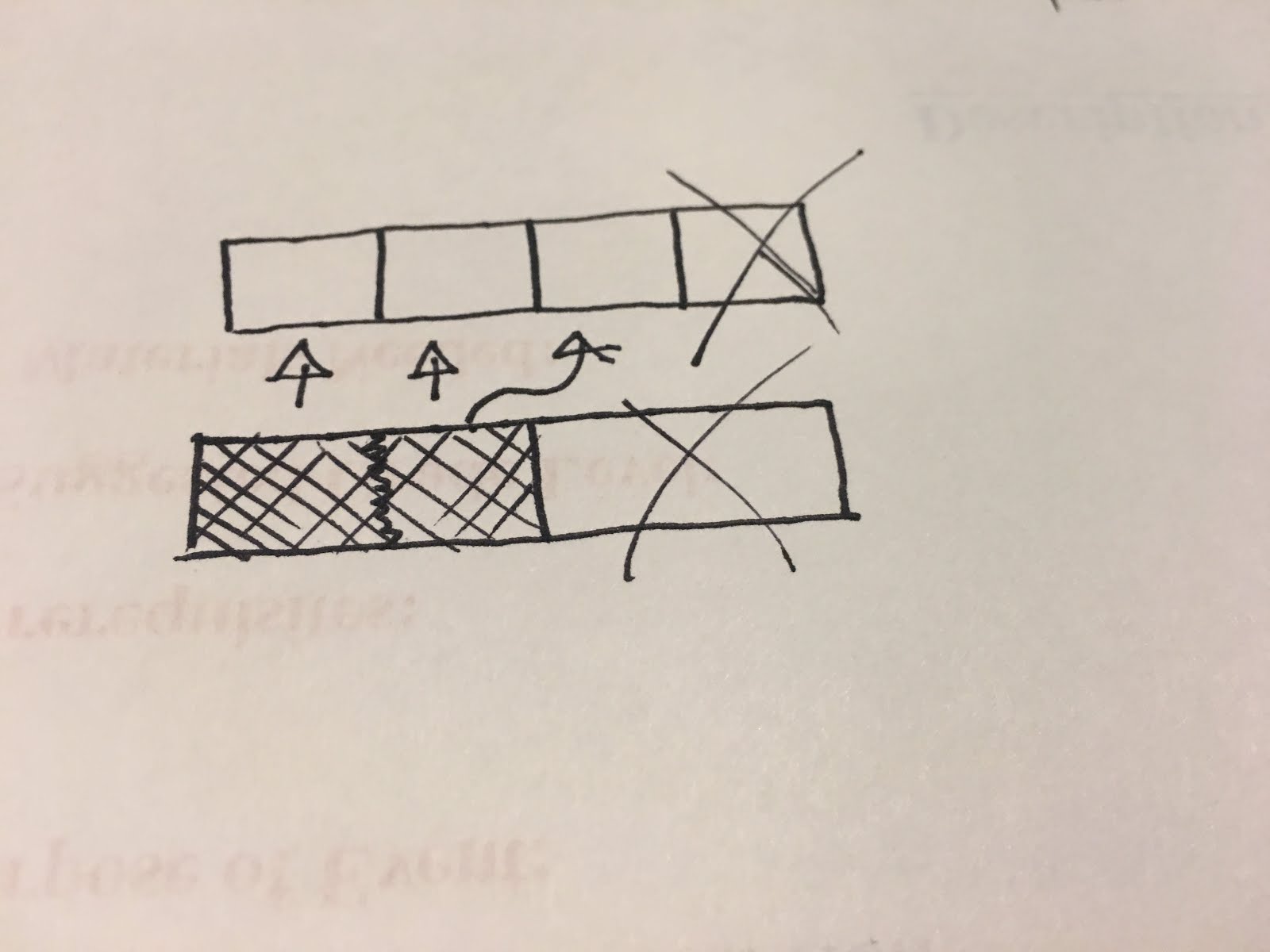
Again, using the third example and the same ideas we have developed in the previous section, we can tackle this problem. We look at 1/2 as one entity and the 3/4 as a second entity. We are trying too see how much of the first entity fits into the second. Again, we can use rectangles to help visualize this in Figure 3; this shows you need 3/2 of 1/2 to fill 3/4 OR 1 1/2 of 1/2 to fill 3/4.
Concluding Thoughts
I hope to continue thinking through the conceptual models of dividing fractions and revisit this post to include an evaluation of dividing complex fractions by complex fractions that I am happy with. At the current time I have not been able to articulate it in a way I feel adds to this blog.
All in all, I hope the first few examples have provided a deeper understanding in to the why and how we divide fractions.
Wednesday, 18 January 2017
My First Teaching Practicum
I had the opportunity to complete my first teaching practicum in my primary teachable; Physical Education. I was in charge of teaching a grade 11 open physical education course of all male students. With this being my first time teaching a course there were number of things that I didn't expect and even more lessons for me to learn.
Going into my practicum I thought that the time it took to lesson plan a lesson each and every day would be the most difficult part. I quickly realized how mistaken that was-yes the lesson planning was time consuming but soon I became accustom to it. In fact, the biggest struggle I found was developing and establishing an effective routine with the class. The student's themselves had a difficult time with maintaining a regular attendance of the class. This made it a struggle to implement any routine at all. I decide to re-think my ideal routines and begin to work through a routine that was tailored to the class.
My routine was based around always having a structured plan for the class but leaving opportunity to take the students feedback into the daily activities. We would start the day with 5 minutes of personal ball time; where the students could use any equipment from the days lesson to warm up and "play" with their peers. The students always responded well to this. From here I would make a judgment call to see if they appeared to all be sufficiently warmed up or if we should do a group warm up. After this we would have a class "huddle" where we looked at the daily learning goals and agenda. The students would then know what to expect for the remainder of the class. Going through the activities of the day the students would be allowed to suggest any modifications to the rules during the instruction periods. This allowed them to have a voice in the activities we engaged in. At the end of the lesson we would debrief and always discuss strategies and tactics used throughout the day; what they found successful what they had difficulties with. We would end this debrief with a review of whether or not they felt they achieved the learning goals from the day. I would use this debrief information to help guide my planning for the next lesson.
Having this routine in place created a structure to the class that I believe the students really appreciated. I could easily see them become more engaged in the lessons and in turn were reaching the learning goals more regularly.
It is for these reasons that I honestly believe one of the most important lessons I learnt during my practicum was how significant a well developed, personalized routine is for the success of a class.
Going into my practicum I thought that the time it took to lesson plan a lesson each and every day would be the most difficult part. I quickly realized how mistaken that was-yes the lesson planning was time consuming but soon I became accustom to it. In fact, the biggest struggle I found was developing and establishing an effective routine with the class. The student's themselves had a difficult time with maintaining a regular attendance of the class. This made it a struggle to implement any routine at all. I decide to re-think my ideal routines and begin to work through a routine that was tailored to the class.
My routine was based around always having a structured plan for the class but leaving opportunity to take the students feedback into the daily activities. We would start the day with 5 minutes of personal ball time; where the students could use any equipment from the days lesson to warm up and "play" with their peers. The students always responded well to this. From here I would make a judgment call to see if they appeared to all be sufficiently warmed up or if we should do a group warm up. After this we would have a class "huddle" where we looked at the daily learning goals and agenda. The students would then know what to expect for the remainder of the class. Going through the activities of the day the students would be allowed to suggest any modifications to the rules during the instruction periods. This allowed them to have a voice in the activities we engaged in. At the end of the lesson we would debrief and always discuss strategies and tactics used throughout the day; what they found successful what they had difficulties with. We would end this debrief with a review of whether or not they felt they achieved the learning goals from the day. I would use this debrief information to help guide my planning for the next lesson.
Having this routine in place created a structure to the class that I believe the students really appreciated. I could easily see them become more engaged in the lessons and in turn were reaching the learning goals more regularly.
It is for these reasons that I honestly believe one of the most important lessons I learnt during my practicum was how significant a well developed, personalized routine is for the success of a class.
Wednesday, 11 January 2017
Reflecting on Online Session 1 and 2 - EDUC 8F83
This blog post is being used as a reflection of two online sessions for my EDBE 3F83 course.
Session 1
In the first online session we dove into the problems with mathematical discussions in the classroom, or more accurately the lack there of. The article Orchestrating Productive mathematical Discussions: Five Practices for Helping Teachers Move Beyond Show and Tell provides a great set of practises to apply to the classroom. These are:
Session 1
In the first online session we dove into the problems with mathematical discussions in the classroom, or more accurately the lack there of. The article Orchestrating Productive mathematical Discussions: Five Practices for Helping Teachers Move Beyond Show and Tell provides a great set of practises to apply to the classroom. These are:
- Anticipating likely student responses to cognitively demanding mathematical tasks
- Monitoring students' responses to the tasks during the explore phase
- Selecting particular students to present their mathematical responses during the discuss-and-summarize phase
- Purposefully sequencing student responses that will be displayed
- Helping the class make mathematical connections between different students' responses and between students' responses and the key ideas.
Using these strategies will help develop a classroom community that encourages and thrives from mathematical discussion. The one practice that really resonated with me is the first one. As a teacher, being able to anticipate students' responses - even the more abstract responses - will prepare you for a more in depth discussion. Furthermore, this will push your classroom into thinking about the problem through a variety of lenses and ultimately gaining a deeper, richer understanding of the problem.
Another aspect of this first online session that I found very important was the idea of developing mathematical curiosity. If we, as educators, can foster a curiosity in the minds of our students they will inevitably be much more driven to resolve problems. Finding creative, effective ways to do this is fundamentally important for the ever-changing classrooms we face. We are well aware of how individually different our students are, for that reason finding a wide variety of ways to spike the interest of students is ever so important.
Session 2
In this session we looked into formative assessment and more specifically into providing feedback as learning. One issue that continually arises in the classroom is the student who has not yet reached the correct solution to the problem. Often they will have taken a few of the correct steps but then somewhere, along the way, misstepped and arrived at an incorrect or incomplete answer. When assessing work it is important for teachers to address this issue in an effective way. Looking back to the first online section and the five practices; practice one will help greatly with this. As a teacher we must attempt to follow the students path of work and see where there was a discourse. From here we need to develop feedback to help the student realize the problem and ultimately correct it. This is a lot easier said than done.
As an educator it is important to keep a few things in mind when providing feedback. It should be positive, help the student diagnose their problem and provide direction. If formative feedback can follow these important features students who are on the cusp of a correct answer will surely self-correct and achieve their potential.
In conclusion, these two online sessions have helped me gain a deeper understanding how to foster mathematical discussions in a classroom as well as provide beneficial formative feedback. Furthermore, it has shown me the incredible importance of being effective at both of these skills.
Cheers,
Mike Studenny
Monday, 31 October 2016
Lesson's With A Good "Hook"
Does Your Lesson Have Context?
When creating a lesson one of the important things a teacher needs to take into consideration is the level of engagement the students will have. Obviously, we want the students as engaged as possible. Now I know understand that many teachers find it necessary to have classes that they lecture and students take notes to help lay some ground work for the upcoming lessons. However, it is important for a teacher to always be critical of their methodology for delivering lessons. Furthermore, teachers need to make sure they are taking the time to get to know their students and decide what delivery would work best with this particular group of students.
When looking at the educators I follow on twitter I seem to see a growing trend of teachers becoming more theatrical in the delivery of their lessons. Below is a great example to check out:
I wouldn't go as a far as saying I'm telling teachers reading this to buy a new costume for each topic and turn your classes into a fully interactive play (although that's kind of an interesting idea to for integrated curriculum with the arts). I am however, strongly encouraging teachers to look at how engaging their lessons are. For me this is can be as easy as devising a creative "hook" to your lesson to capture your students attention (i.e., Captain Hook)
In the bigger picture, the point I am trying to make is to make sure that lessons provide some kind of context to them. This makes is so much easier to answer the time old question "why do we need to learn this. " Adding context to your questions whether it's bringing in the latest viral video or making math questions about real life problems this question quickly begins to be asked significantly less.
Do you have a unique way to add context to your lessons? Feel free to add your opinions to the comments below.
20 Books BY Teachers, FOR Teachers to Inspire Your Teaching via #DitchBook author, @jmattmiller https://t.co/VEVScqRxr1 #tlap pic.twitter.com/5GPCQ9g5ZH— Dave Burgess (@burgessdave) October 18, 2016
 |
| Retrieved From: capt_hook3.jpg |

I wouldn't go as a far as saying I'm telling teachers reading this to buy a new costume for each topic and turn your classes into a fully interactive play (although that's kind of an interesting idea to for integrated curriculum with the arts). I am however, strongly encouraging teachers to look at how engaging their lessons are. For me this is can be as easy as devising a creative "hook" to your lesson to capture your students attention (i.e., Captain Hook)
In the bigger picture, the point I am trying to make is to make sure that lessons provide some kind of context to them. This makes is so much easier to answer the time old question "why do we need to learn this. " Adding context to your questions whether it's bringing in the latest viral video or making math questions about real life problems this question quickly begins to be asked significantly less.
Do you have a unique way to add context to your lessons? Feel free to add your opinions to the comments below.
Sunday, 23 October 2016
Technology's Place In The Math Classroom
With the majority of my education having taken place in the 21st century it is easy for me to see what an integral role technology has played in the classroom. Almost as a minimum teachers are using projectors and slide presentations a daily norm in the classroom. But to what degree should or can the education system incorporate technology into the classroom?
I believe it is easier to address the what can be used in the classroom so I will do that first. Honestly, the options are quickly becoming endless. Initially cost and internet connectivity were combined a monstrous inhibitor to technology in the classroom. However, as technology progresses so does the ease of it's integration. Numerous students have their own PED and are able to bring these to the classroom. This is just a starting point though; teachers are able to use free websites such as Padlet, Secretive, Google Classroom, PollEV, Kahoo and countless others.
It is clear that teachers have many websites and programs that are easily accessible to them. The next thing to think about is which types/forms/means of technology should be used in the classroom? I think the easiest way to address this issue is to look at from the perspective of our student's success. If the technology helps create an inclusive environment, helps the student(s) achieve learning objectives or aids in maintaining the engagement of the student(s) I believe it is easily justified to be used.
Another way we can look at this is presented through this article from EdTech; a website that is based around the use of technology in an education setting. I recommend at least taking a look at this article but the website as an entirety is fantastic.
In conclusion; I truly believe that incorporating technology into the classroom can help a number of students. However, one important thing to remember is that technology should always be used as a compliment to the teacher not instead of the teacher.
Feel free to let me know how you use technology in the classroom or any of your opinions on the use of technology in the classroom. You can do this by commenting below
EDIT:
I found an awesome infographic today on one of my favourite Tech Based educator's twitter feed. Alice Keeler suggests that we should be moving anything that isn't better on paper to a digital platform as a means to upgrade it. I wouldn't go as far as saying that you should be filling out this flow chart every time you make a lesson and moving all of your content online. However, I do think it should be in the back of teacher's minds to be critical about the means used to deliver a lesson. Thinking about whether this could, as well as should, be done through a digital platform is always an important Especially as we move more and more into the digital age. Check out the infographic below:
Cheers,
Mr. Studenny
I believe it is easier to address the what can be used in the classroom so I will do that first. Honestly, the options are quickly becoming endless. Initially cost and internet connectivity were combined a monstrous inhibitor to technology in the classroom. However, as technology progresses so does the ease of it's integration. Numerous students have their own PED and are able to bring these to the classroom. This is just a starting point though; teachers are able to use free websites such as Padlet, Secretive, Google Classroom, PollEV, Kahoo and countless others.
It is clear that teachers have many websites and programs that are easily accessible to them. The next thing to think about is which types/forms/means of technology should be used in the classroom? I think the easiest way to address this issue is to look at from the perspective of our student's success. If the technology helps create an inclusive environment, helps the student(s) achieve learning objectives or aids in maintaining the engagement of the student(s) I believe it is easily justified to be used.
Another way we can look at this is presented through this article from EdTech; a website that is based around the use of technology in an education setting. I recommend at least taking a look at this article but the website as an entirety is fantastic.
In conclusion; I truly believe that incorporating technology into the classroom can help a number of students. However, one important thing to remember is that technology should always be used as a compliment to the teacher not instead of the teacher.
Feel free to let me know how you use technology in the classroom or any of your opinions on the use of technology in the classroom. You can do this by commenting below
EDIT:
I found an awesome infographic today on one of my favourite Tech Based educator's twitter feed. Alice Keeler suggests that we should be moving anything that isn't better on paper to a digital platform as a means to upgrade it. I wouldn't go as far as saying that you should be filling out this flow chart every time you make a lesson and moving all of your content online. However, I do think it should be in the back of teacher's minds to be critical about the means used to deliver a lesson. Thinking about whether this could, as well as should, be done through a digital platform is always an important Especially as we move more and more into the digital age. Check out the infographic below:
How Is This Better Than Paper? https://t.co/x4Bl6HEDzP pic.twitter.com/am8aeuEWW7— Alice Keeler (@alicekeeler) October 31, 2016
Cheers,
Mr. Studenny
Saturday, 8 October 2016
Gaps In The Classroom
Students often find lessons difficult to understand or keep up with. I'm sure a lot of my readers can look back on their time in grade 9 or 10 math and remember feeling totally and completely lost. That feeling when the teacher is talking about something and you have literally no clue what they mean. That feeling, if your like myself, leaves you stressed, anxious and incredibly uncomfortable. It is almost as though you are missing that one piece of the puzzle to complete it.
At this point of your read I encourage you to go to the following google drawings page and attempt to get get all the blue shapes inside the black square. Attempt to do so without manipulating the shapes orientation or size or using the red square to complete. (EDIT: Please when you're are done return the shapes to their initial positions at the top, not necessarily in the order they are right now)
You will quickly find that without the red square it is impossible to fully complete this challenge.
You can think that each of your teachers are giving you one piece of the puzzle that will let you create a final product. However, imagine one of your teachers fails to successfully give you the piece. No matter how much you try you can't complete the puzzle.
One of the biggest struggles as a teacher is to determine where students gaps in their knowledge and understanding is and how to combat this. This struggle with putting the puzzle together gives a small insight into how students struggle when they have gaps in their education. With this in mind it is entirely reasonable for these students to not be able to meet the standards in classrooms.
So how do we determine which students have gaps and what those gaps are?
This is defiantly the big question for teachers with regards to students who are underachieving. There are a number of techniques that teachers can use to help identify these gaps:
At this point of your read I encourage you to go to the following google drawings page and attempt to get get all the blue shapes inside the black square. Attempt to do so without manipulating the shapes orientation or size or using the red square to complete. (EDIT: Please when you're are done return the shapes to their initial positions at the top, not necessarily in the order they are right now)
You will quickly find that without the red square it is impossible to fully complete this challenge.
You can think that each of your teachers are giving you one piece of the puzzle that will let you create a final product. However, imagine one of your teachers fails to successfully give you the piece. No matter how much you try you can't complete the puzzle.
One of the biggest struggles as a teacher is to determine where students gaps in their knowledge and understanding is and how to combat this. This struggle with putting the puzzle together gives a small insight into how students struggle when they have gaps in their education. With this in mind it is entirely reasonable for these students to not be able to meet the standards in classrooms.
So how do we determine which students have gaps and what those gaps are?
This is defiantly the big question for teachers with regards to students who are underachieving. There are a number of techniques that teachers can use to help identify these gaps:
- Diagnostic Assessments: before diving into new material taking the time to establish a baseline and make sure students understand all prior material that is necessary to move forward.
- Observing Conversations: a carefully trained ear can allow a teacher to pick up on subtleties in vocabulary and other communication skills that suggest gaps.
- Analyzing Answers: working through a students thought process can tell the teacher a lot about how they approach problems and what their gaps or strong suits may be.
- Ministry Support: the MOE provides resources to help address gaps students face. These can be found through the website Edugains.
To conclude; it is imperative that teachers take the time to identify students who have gaps in their knowledge and furthermore, take the initiative to close these gaps. Through this process our teachers will be able to provide tools to certain underachieving students that will help them succeed.
Are you a teacher that has a strategy they use to close gaps? Feel free to share in the comments.
Are you a student who has faced a similar struggle? Feel free to share our story or insights in the comments.
Do you have any questions? I strongly encourage you to ask!
Are you a teacher that has a strategy they use to close gaps? Feel free to share in the comments.
Are you a student who has faced a similar struggle? Feel free to share our story or insights in the comments.
Do you have any questions? I strongly encourage you to ask!
Subscribe to:
Posts (Atom)